How to hold a padel racket
One grip does nearly all the work in padel. Here is how to find it, how tightly to hold it, when an alternative makes sense, and the grip habits that quietly cost beginners points.
Hold a padel racket with a continental grip: pick it up the way you would hold a hammer, or shake hands with the handle while the face points sideways rather than up. Use it for the serve, volleys, the bandeja, the víbora, the smash and shots off the glass, so you never have to change grip in a fast exchange at the net. Keep your hand relaxed, firm only at contact, and wear the wrist cord, which the FIP rules make obligatory. Some players rotate slightly towards an eastern grip for baseline forehands when there is time. Avoid the frying-pan grip with the face pointing at the sky.
Key takeaways
- The continental (“hammer”) grip covers nearly every padel shot.
- Net exchanges are too quick to switch grips, so a one-grip game is a faster game.
- An eastern forehand grip is an optional extra for baseline drives, not a second default.
- Grip pressure should be relaxed; a death grip slows the racket and tires the forearm.
- The wrist cord isn’t optional: FIP rules require a non-elastic cord of up to 35 cm, worn on the wrist.
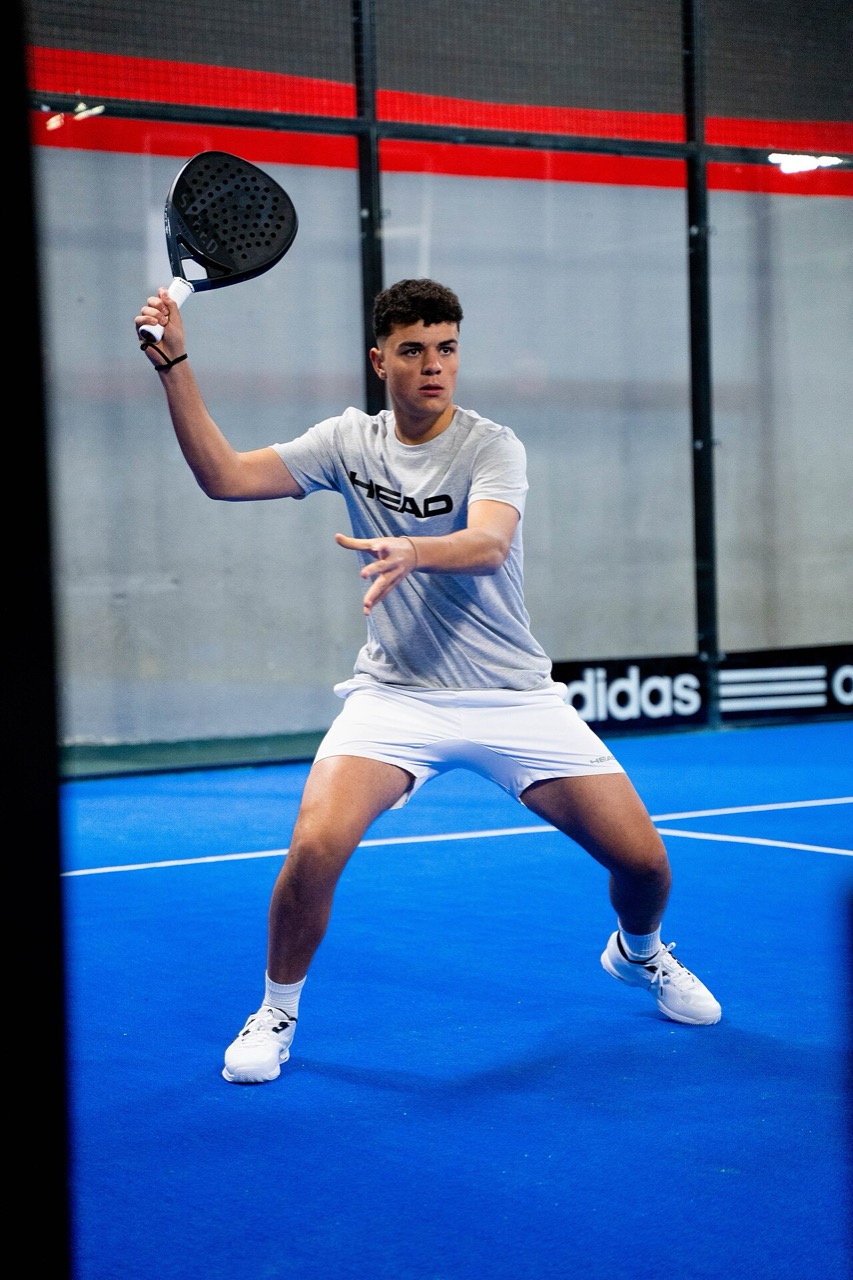
Why padel is basically a one-grip game
Tennis players switch grips all the time: eastern or semi-western for forehands, something else for backhands, continental for volleys and serves. Padel compresses that. The court is 20 by 10 metres, it is almost always played as doubles, and the team at the net usually controls the point. Most of your shots are volleys, blocks, overheads and balls coming off the glass, which are exactly the shots the continental grip was made for.
The other reason is time. At the net, balls arrive quickly and from both sides. A player who changes grip between a forehand and a backhand volley is always half a beat late. Coaching resources, including Babolat’s padel technique guidance, generally teach the continental grip as the base for the whole game for that reason. Our padel shots guide shows how each shot builds on it.
How to find the continental grip in ten seconds
- Hold the racket by the throat with your other hand, the face vertical, so the frame edge points at the floor and the ceiling.
- Shake hands with the handle, or wrap your hand around it as if the frame edge were the head of a hammer you were about to drive a nail with.
- Check the V. The V formed by your thumb and index finger should sit roughly along the top edge of the handle, not on the flat of the handle facing up.
- Spread the index finger slightly up the handle, like a trigger finger. It gives you more feel for where the face is pointing.
- Look at the face. With your arm out in front, the face should point slightly up and forwards, which is the open face you want on volleys and slices.
If it feels odd on forehands at first, that is normal for players coming from tennis or no racket sport at all. Give it a few sessions before you decide it doesn’t work.
Which grip for which shot
| Shot | Grip | Why |
|---|---|---|
| Serve | Continental | Underhand, below the waist; the same grip you will volley with. |
| Forehand and backhand volleys | Continental | No time to change at the net; face stays slightly open for control. |
| Bandeja and víbora | Continental | The slice on these overheads comes from the grip and an open face. |
| Smash | Continental | Same grip as the bandeja, so opponents can’t read which is coming. |
| Back-wall exits and lobs | Continental | An open face lifts the ball and keeps it under control off the glass. |
| Baseline forehand drive | Continental or slight eastern | Optional rotation when you have time; switch back before you move forward. |
This is the common coaching default, not a law. A coach who watches you play may adjust it, particularly on the forehand. The point is that you start from one grip and only move away from it for a reason.
The eastern forehand: an optional extra
Some coaches let players rotate their hand slightly behind the handle, towards an eastern forehand grip, for drives from the back of the court when the ball sits up and there is time. For a right-hander that means turning the hand a little clockwise. It can make a flat forehand feel more natural, especially for former tennis players.
The catch is the switch back. If you rotate for a drive and then move forward to the net, you need to be back in continental before the next ball arrives. Many beginners are better off staying continental for everything until the basics are automatic. Tennis grips built for heavy topspin, such as semi-western and western, rarely suit padel: the rackets are short and solid, the balls stay low, and the walls punish big swings.
Put the grip to work on court
A grip only sticks with repetition. Find a court near you, book an off-peak hour and run a volley rally with one rule: no grip changes.
How tight to hold it
Grip pressure matters as much as grip position. Beginners tend to squeeze hard all the time, which slows the racket head, kills feel on soft shots and tires the forearm. A useful cue from coaching is to keep the hand relaxed while you wait and firm up only as you make contact, just enough that the face doesn’t twist. On touch shots such as drop volleys and the chiquita, softer still.
If your forearm or elbow aches after playing, grip tension is one of the first things worth checking, along with the racket itself. Our padel injuries guide covers overuse problems; persistent pain is a reason to see a clinician, not to push through.
Where on the handle to hold it
Most players hold near the end of the handle for groundstrokes and overheads, which gives the most reach and leverage. At the net, some players choke up slightly, sliding the hand a little towards the throat for faster, more compact volleys. Both are fine. What you want to avoid is a hand so far down that the heel of your palm is hanging off the butt cap, which costs control.
Handle thickness changes how the grip feels. A handle that is too thin can make you squeeze harder; too thick and wrist action gets stiff. Players adjust it with overgrips. Our overgrip guide explains how a fresh overgrip changes tack and thickness and when to replace one.
The wrist cord: required, not decoration
Every padel racket comes with a cord on the handle, and it is there for a reason. The International Padel Federation’s Rules of Padel say the racket must have a non-elastic cord or strap fixed to the handle, no longer than 35 cm, and that wearing it around the wrist is obligatory. Rackets are solid and heavy enough to hurt someone if they slip during a smash, and partners stand close together. Put the cord on before you pick a grip, and adjust the toggle so it’s snug without cutting off circulation.
Common grip mistakes
- The frying-pan grip. Holding the racket with the face pointing at the sky feels natural to new players, but it closes off backhands and makes volleys hard to control.
- Switching grips at the net. If you are changing grip between forehand and backhand volleys, you will be late on fast exchanges.
- Squeezing all the time. Tension belongs at contact, not between shots.
- Hitting overheads with a forehand grip. It flattens the face and removes the slice that makes a bandeja safe.
- Ignoring a slick handle. If the racket twists in your hand, change the overgrip before you change your technique.
Our beginner mistakes guide covers the positioning and wall habits that usually show up alongside these.
Two grip drills
One-grip volley rally. With a partner at the net, volley back and forth without letting the ball bounce. The only rule is that nobody adjusts their hand. If you catch yourself switching, reset and start the count again.
Shadow overheads. Without a ball, take a continental grip, turn side-on and shadow ten bandejas and ten smashes, checking that the hand doesn’t drift towards a forehand grip. Then do the same with a partner feeding gentle lobs. Our padel drills for beginners has more sessions to slot this into.
Frequently asked questions
What is the correct way to hold a padel racket?
Most players and coaches use the continental grip for nearly every shot: hold the racket as if you were holding a hammer or shaking hands with it, with the frame edge pointing up and down rather than the face pointing at the sky. It lets you hit forehand and backhand volleys, the bandeja, the víbora, the smash and the serve without changing grip, which matters because padel exchanges at the net are too fast to switch.
Should I use a continental or eastern grip in padel?
Continental for almost everything. Some coaches let players rotate slightly towards an eastern forehand grip for baseline forehands when there is time, because it can make a drive feel more natural. Grips used for heavy topspin in tennis, such as semi-western and western, generally don’t suit padel’s low, short rackets and walls.
How tight should I grip a padel racket?
Looser than most beginners do. A relaxed hand between shots lets the racket head move and reduces forearm fatigue. Many coaches describe it as firm enough that the racket won’t twist on contact and no tighter. If your forearm aches after an hour, a death grip is a common reason.
Do you have to wear the wrist strap on a padel racket?
Yes, in rules-based play. The International Padel Federation’s rules say the racket must have a non-elastic cord no longer than 35 cm fixed to the handle, and that wearing it around the wrist is obligatory. It keeps a racket that slips from flying into a partner, an opponent or the glass.
Can I use two hands on a padel backhand?
Some players do on certain balls, especially newer players coming from tennis, but the one-handed continental backhand is the standard in padel because most backhands are volleys, blocks and wall exits where a two-handed swing has less room. If you want to try it, ask a coach to check that it isn’t covering a grip or footwork problem.
Make sure the racket fits the grip
A forgiving racket and a fresh overgrip make the continental grip easier to learn. Compare beginner options, then find a court to try them on.
Last updated October 23, 2026 · PadelAnywhere Editorial
Sources
The wrist cord requirement is from the International Padel Federation Rules of Padel (non-elastic cord, maximum 35 cm, obligatory). Grip guidance is cross-checked against Babolat’s padel hitting techniques and the Padel Encyclopedia’s grips page (continental as the base grip, optional eastern for baseline forehands). Your coach’s advice on your own technique takes priority over any written guide.