Padel eye protection: do you need protective glasses?
Most padel players never think about their eyes until a ball comes off the glass at the wrong angle. Here is what eye doctors have actually found, what real protection looks like, and what to do if you get hit.
Eye protection isn’t required in recreational padel, but the case for it is stronger than most players assume. In one Swedish county, padel became the leading cause of sports-related eye injuries needing care by 2021, and nearly all of those injuries came from the ball. A Spanish hospital series of 34 serious padel eye injuries found that no one was wearing protection. If you want protection, choose sports eyewear with polycarbonate lenses tested to a racket-sport standard such as ASTM F3164. Everyday glasses and sunglasses are not protection and can make an injury worse. After any ball strike to the eye, get checked, even if you can still see well.
Key takeaways
- Published studies from Sweden, Spain and Italy all report padel eye injuries, almost all caused by the ball.
- The risk comes from close net exchanges, fast balls and unpredictable rebounds off glass.
- Most injuries are mild, but some involve the retina and need surgery.
- Regular glasses, sunglasses and contacts don’t protect your eyes from a ball.
- Look for polycarbonate racket-sport eyewear tested to ASTM F3164 or the CSA racquet sports standard.
- Any hit to the eye deserves an eye exam, even when vision seems normal.
What the eye-injury research actually shows
Padel is still young as a research topic, and nobody has a large, worldwide injury rate yet. What exists is a handful of studies from countries where padel boomed early. They point the same way.
| Study | What it looked at | Key finding |
|---|---|---|
| Jönköping County, Sweden (Acta Ophthalmologica) | 255 patients treated for sports eye injuries, 2017–2021 | Padel caused 20% overall and became the leading cause in 2021; the ball caused almost all padel injuries; 4% had severe consequences |
| Swedish case report (Läkartidningen, 2021) | Three padel ball injuries in 2020 | All three needed surgery for retinal tears or detachment |
| Spanish hospital series (Acta Ophthalmologica, 2022) | 34 patients with injuries to the back of the eye over three years | Retinal tears, detachments and bleeding; none of the players wore eye protection |
| Italian national survey (Eye, 2026) | 583 padel players, April 2024–March 2025 | 10.3% reported an eye injury, 92% of those from the ball; 10% of the injured had eye surgery; only 9.6% strongly supported wearing goggles |
Two cautions. The Italian study is a voluntary online survey, so people who had been injured may have been more likely to answer; it tells you injuries happen and what kind, not how often they happen to the average player. And the Swedish register covers one county. Even so, every source agrees that the ball is the main cause and that serious injuries, while not common, are not rare flukes either. In the Italian survey, the only factor independently linked to reporting an injury was how often people played: the odds climbed steeply for players on court four to six times a week compared with less than once a week.
Why padel is harder on eyes than it looks
Padel feels gentler than tennis. The court is smaller, the serve is underarm, and the balls are slightly lower-pressure. The researchers behind the Swedish case report point to the details that change the picture:
- Distance. In doubles at the net, opponents are often only a few metres apart, and the point is decided by volleys and blocks hit hard and flat. There’s very little time to react to a ball aimed at your body.
- Ball size and speed. The Swedish authors list the size and velocity of the padel ball among the circumstances that may raise eye risk, and a full volley or smash at close range leaves almost no reaction time.
- Rebounds off the glass. Balls come off the back and side walls at angles that are hard to read, especially for newer players turning to follow the ball.
- Your own partner. Many hits come from a partner’s shot or a ball that clips the frame. The Italian survey also recorded a few injuries from players’ own rackets.
Positioning helps too. Our doubles strategy guide covers how to stand at the net and when to back off, and a good coach will teach you to keep the racket up in front of your face in the ready position.
The types of injury eye doctors see
Most padel eye injuries reported in these studies were mild or moderate. In the Italian survey the most common were scratches on the cornea (corneal abrasion) and bleeding under the clear surface of the white of the eye (subconjunctival hemorrhage). Those usually heal. The worrying group involves the back of the eye: bleeding inside the eye, retinal swelling, retinal tears, retinal detachment and damage that can lead to glaucoma. The Spanish series found that many of these patients still had good vision when they first arrived, which is exactly why a ball to the eye shouldn’t be shrugged off.
Shopping for padel eye protection?
Look for racket-sport goggles with polycarbonate lenses and the testing standard printed on the box. We haven’t tested any eyewear ourselves; the search below shows current options and prices on Amazon.
What real eye protection looks like
Sports eye protection is not a fashion accessory or a tinted lens. The American Academy of Ophthalmology recommends protective sports glasses with shatter-resistant polycarbonate lenses for racket sports, and eye protectors tested to ASTM standards or that pass the CSA racquet sports standard. Here’s how to read what you’re buying:
- ASTM F3164. The ASTM specification for eye protectors for racket sports. Its scope names racquetball, squash, tennis and pickleball, and it covers impact and penetration by rackets, paddles and balls. Padel isn’t named, and we didn’t find a padel-specific eyewear standard, so this is the closest fit. The standard recommends polycarbonate as the most impact-resistant lens material.
- ASTM F803. An older and broader sports eyewear specification. Its current version focuses on basketball, baseball and soccer, so for padel the racket-sport standard is the better match.
- Polycarbonate lenses. Shatter-resistant and also blocks UV, which matters on outdoor courts. Glass lenses and standard plastic lenses are not the same thing.
- A wraparound frame that stays put. Look for a design that sits close to the face, covers the eye from the side and has a strap or secure temples so it doesn’t move when you lunge.
- Anti-fog. Not a safety feature, but if goggles fog up you’ll take them off. Indoor courts and humid summer evenings are where this matters most.
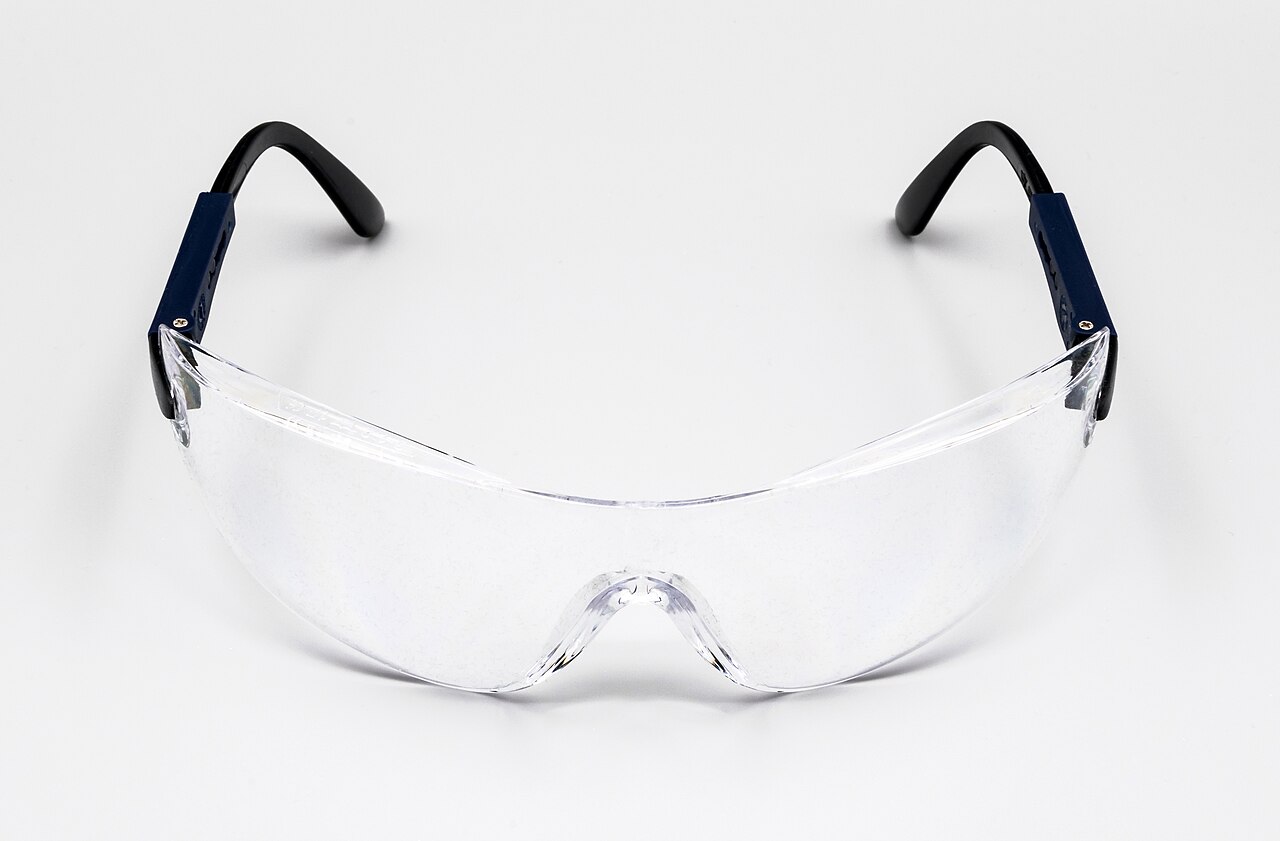
Industrial safety glasses (like the pair pictured above) are rated against workplace hazards, not a racket-sport ball strike. They may be better than nothing, but they aren’t designed or tested for this use. Check the label rather than assuming.
If you wear prescription glasses or contacts
Ordinary prescription frames are not protection. The American Academy of Ophthalmology warns that regular eyeglasses can make an injury worse if they shatter, and the National Eye Institute notes that glasses, sunglasses and contact lenses don’t protect against sports eye injuries. Your options are sports goggles made with your prescription, or protective goggles designed to fit over glasses or worn with contacts. An optometrist or ophthalmologist can advise on which works for your eyes, and that’s a better source than a gear blog. If you already have reduced vision in one eye, talk to your eye doctor before playing at all; the AAO specifically flags this as a reason to think hard about the risk.
Why so few padel players wear it
In the Italian survey, fewer than one in ten respondents strongly supported wearing goggles. That matches what you see at most clubs. The reasons are familiar from other sports: it isn’t required, few professionals wear it, goggles can fog or feel awkward, and many people think of padel as low risk. Squash and racquetball went through the same debate decades ago, and protective eyewear is now normal in those sports at many levels. Padel may or may not follow. If you play several times a week, play a lot of net exchanges against hard hitters, or have had an eye problem before, the risk is worth weighing. Our what to wear to play padel guide covers the rest of your kit.
Kids and junior players
The National Eye Institute calls eye injuries a leading cause of blindness in children in the United States and says most happen during sports. It also says the right protective eyewear can prevent 9 out of 10 sports-related eye injuries, and that youth leagues don’t always require it. For junior padel, the usual extra factors apply: shorter players have the ball closer to eye level at the net, and kids are still learning to read the glass. Junior racket-sport goggles exist; get a pair that fits snugly rather than an adult pair that slides. Our padel for kids and juniors guide covers the rest of the junior setup.
What to do if a ball hits your eye
This is general information, not medical advice. If you take a ball to the eye:
- Stop playing. Don’t rub the eye or press on it.
- Get it examined by an eye-care professional promptly, even if you can see normally. The Spanish ophthalmologists recommend examining the back of the eye after any blunt ball strike, regardless of how good vision is at first.
- Go to urgent care or an emergency department for new floaters, flashes of light, a shadow or curtain over part of your vision, worsening pain, blood visible in the eye, or blurred or double vision.
- Don’t go back on court until you’ve been cleared.
For the other injuries padel players pick up, mostly elbows, shoulders, calves and knees, see our padel injuries guide.
Frequently asked questions
Do you need eye protection for padel?
It isn’t required for recreational play, and most club players don’t wear it, but eye doctors who have studied padel injuries recommend it. A Swedish register study found padel had become the leading cause of sports-related eye injuries treated in one county by 2021, and a Spanish hospital series of 34 serious padel eye injuries found that none of the injured players wore protection. Whether you wear it is your call; the evidence says the risk is real.
Can a padel ball damage your eye?
Yes. Almost all padel eye injuries in the published studies came from the ball. Reported injuries range from corneal abrasions and bleeding on the white of the eye to retinal tears and retinal detachment that needed surgery. Researchers point to the ball’s size and speed, unpredictable rebounds off the glass and the short distance between players at the net.
Are regular glasses or sunglasses enough protection for padel?
No. The American Academy of Ophthalmology says regular eyeglasses don’t provide proper eye protection and can make an injury worse if they shatter. The National Eye Institute says the same about sunglasses and contact lenses. Sports eye protection uses impact-resistant polycarbonate lenses in a frame built to take a hit.
What standard should padel eye protection meet?
There is no padel-specific eyewear standard that we could find. The closest is ASTM F3164, the specification for eye protectors for racket sports, which names racquetball, squash, tennis and pickleball and recommends polycarbonate lenses. The American Academy of Ophthalmology advises choosing eye protectors tested to ASTM standards or to the CSA racquet sports standard. Look for the standard printed on the packaging or product.
What should I do if a padel ball hits my eye?
Stop playing and get your eye checked by an eye-care professional promptly, even if your vision seems fine. Spanish ophthalmologists who reviewed padel injuries advise a full examination of the back of the eye after any blunt ball strike, because serious retinal damage can occur with good initial vision. Seek urgent care for new floaters, flashes of light, a shadow or curtain over your vision, pain or blurred vision.
Should kids wear eye protection for padel?
It’s worth considering. Children are shorter, so balls at the net arrive closer to eye level, and juniors are still learning to judge rebounds off the glass. The National Eye Institute says the right protective eyewear can prevent 9 out of 10 sports-related eye injuries, and that youth leagues don’t always require it. Junior-sized racket-sport goggles exist; check fit and the standard on the label.
Protect your eyes, then get playing
Check current racket-sport eyewear on Amazon, or round out your bag with the rest of the padel kit.
Last updated October 29, 2026 · PadelAnywhere Editorial · This page is general information, not medical advice. See an eye-care professional about your own eyes.
Sources
- “Padel an increasing cause of sport-related eye injuries in Sweden,” Acta Ophthalmologica (Jönköping County register, 2017–2021).
- “Eye injuries related to padel,” Läkartidningen, 2021 (PubMed abstract).
- “Vitreo-retinal injuries in the practice of padel, a problem on the rise,” Acta Ophthalmologica, 2022.
- “Ocular injuries in padel: findings from a survey on frequency, risk factors, and perceptions toward protective eyewear,” Eye, 2026.
- American Academy of Ophthalmology: Sports Eye Safety.
- National Eye Institute: Sports and Eye Safety, Tips for Parents and Teachers.
- ASTM F3164-24: Standard Specification for Eye Protectors for Racket Sports and ASTM F803 (scope summaries).