Padel racket for tennis elbow: what actually matters
A sore outer elbow is the most common complaint in padel, and the racket is usually the first thing players want to change. Here is which specs are worth chasing, where the evidence runs out, and what else has to change with it.
Look for a soft core, a low or even balance, a moderate weight and a forgiving head. In practice that means an EVA or foam core described as soft, a balance listed as low or even rather than high, roughly 345 to 360 g, and usually a round shape. A fiberglass face is often suggested as gentler than stiff carbon. That is the consensus from specialist shops and sports clinics, but it is advice built on mechanics, not on trials: no study we could find shows that any racket prevents or treats padel elbow. The racket is one lever. How tightly you grip, how often you hit off-center, how much you play and whether you have had the arm looked at matter just as much.
Why padel is hard on the outer elbow
Tennis elbow, or lateral epicondylitis, is an overuse problem in the tendons on the outside of the elbow, the ones that extend your wrist. The NHS describes the main symptom as pain on the outside of the elbow that is often worse when gripping objects, lifting or bending the arm, or moving the wrist. A review in the British Journal of Sports Medicine (De Smedt and colleagues, 2007) traces it in tennis mainly to repeated load on one wrist extensor muscle, with poor technique, off-center contact and grip tension all in the picture.
Padel loads the same tissue in its own way. The racket is solid, with no strings to give, and most of the game is played close to the net, where volleys, blocks and short defensive punches come fast and often get taken late. Many players coming from tennis also keep a firm grip all point long. Our padel injuries guide covers the published research on how often the elbow shows up, which is the reason a racket choice built around comfort is worth thinking about at all.
The four specs that matter, in order
When you compare rackets, read the spec sheet in this order. Each one changes how much force, and how much shock, the racket hands back to your forearm.
1. Balance: keep the weight near your hand
Balance tells you where the weight sits along the racket. A head-heavy (high balance) racket puts more mass further from your wrist, which helps power but increases the leverage your forearm has to control on every swing and every mishit. A low or even balance keeps that mass closer to the handle. If you only change one thing, change this. Our guide to padel racket weight and balance explains how balance is measured in millimeters and how an overgrip or protector tape moves it.
2. Core: soft over hard
Padel cores are mostly EVA rubber or softer foam. Harder EVA gives a crisp, powerful response and more feedback, which also means more of the impact travels up the handle. Softer EVA and foam compress more on contact. Brands use their own names, so read the description: words like soft, comfort or low density point one way, and hard, power or high density point the other. Our racket materials guide goes through core and face options in more detail.
3. Weight: moderate, not featherweight
Most comfort-oriented advice lands around 345 to 360 g. Heavier rackets carry more momentum into the ball and more load through the arm. Very light rackets have the opposite problem: you tend to swing harder to get depth, and there is less mass to soak up a hard incoming ball. Weight and balance work together, so a 360 g racket with a low balance can feel easier on the arm than a 350 g racket that is head-heavy.
4. Shape and sweet spot: forgiving beats powerful
Round rackets usually have a lower balance and a sweet spot closer to the center of the face, so ordinary mishits are less jarring. Diamond rackets usually push the weight and the sweet spot up toward the tip. That is the theory, and it is mostly right, but not always: a 2023 study in the journal Sensors (Blanes and colleagues, Universitat Politècnica de València) used a robot to strike 225 padel rackets and found the sweet spot position was independent of shape, balance and weight. The practical lesson is that shape is a decent shortcut, not a guarantee, and that hitting the center of whatever racket you own is what cuts vibration. Our racket shapes guide covers the trade-offs.
| Spec | Elbow-friendlier choice | Harder on the arm | How strong is the case? |
|---|---|---|---|
| Balance | Low or even | High (head-heavy) | Mechanical reasoning and wide agreement; not tested in padel trials |
| Core | Soft EVA or foam | Hard or high-density EVA | Shop and clinic advice; no padel study on cores and injury |
| Weight | About 345 to 360 g | Heavy end of the range, or very light | Advice; tennis review links improper racket weight to forearm load |
| Shape | Round | Diamond | A reasonable shortcut; robot testing shows sweet spot is not set by shape |
| Face | Fiberglass | Stiff high-K carbon | Weak; often suggested, little direct evidence either way |
What the research does not support
A lot of comfort marketing outruns the evidence, and it is worth knowing where. The tennis research is the closest we have. In a University of Birmingham study published in 2004, string vibration dampers did not reduce the frame vibration reaching the wrist or elbow, and an earlier study found they did not change how uncomfortable impacts felt. Padel rackets have no strings, but brands now sell frames, handles and grips with their own anti-vibration systems. Some cite lab figures for vibration at the handle. We have not found independent clinical research showing that any of those systems lowers the rate of elbow injury, so we would not pay a large premium for one on that basis alone.
The same BJSM review is useful in the other direction. It reports that in tennis, a larger head and a racket with a higher resonance frequency were associated with less arm vibration, and that experienced players transmit less shock to the arm than recreational ones, in part because they release grip tension quickly after contact. That last point is a technique finding, and it applies on a padel court too.
Our control-oriented list is the natural place to start: rackets that lean round, lower in balance and softer in feel. Specs come from manufacturer listings, and our assessments are based on those specs unless a racket is marked as tested.
Reading three rackets from our database
Here is how the checklist plays out on rackets we already list. These figures are the published specs recorded on each racket page, not our own measurements, and none of these three has been hands-on tested by us yet.
- HEAD Evo Speed: round, low balance, fiberglass face, a core HEAD calls Soft Foam, 350 g. It ticks every box on the checklist and sits in the budget tier. The trade-off is entry-level materials and limited top-end performance for stronger players.
- Babolat Air Vertuo: even balance, fiberglass face, a medium-soft EVA core, 345 g (±10 g). A lighter, maneuverable control racket from Babolat’s Air line. Its exact head shape varies by model year, so check the version in front of you.
- Wilson Bela Pro V3: listed as round, but with a high (head-heavy) balance, a 24K carbon face, a high-density foam core and 370 g. It is a good example of why shape alone is not enough. On paper this is a control racket, yet nearly every spec that matters for a sore elbow points the other way.
If you already own a head-heavy diamond and love it, the fact that it feels powerful is exactly the thing your elbow is paying for. That does not mean you have to sell it, but it is worth having a second, gentler racket for the weeks when the arm is grumbling.
Setup changes that cost almost nothing
Before you buy anything, look at what is already on your racket. Small changes add up on a solid-faced racket.
- Check the grip. A handle that is too thin can lead you to squeeze harder to stop it turning. The tennis evidence on grip size itself is weak, so the goal is simple: a grip you can hold loosely. Our grip size guide shows how to build it up with overgrips.
- Mind the tape and the overgrips. Protector tape on the frame adds weight at the head and raises the balance. Overgrips add weight at the handle and lower it. Two or three overgrips plus a heavy protector can quietly change how a racket loads your arm.
- Replace a dead or damaged racket. A cracked frame or a core that has gone soft and uneven changes how the face responds. Our guide on how long a padel racket lasts covers the signs.
- Use fresh balls. Old, flat balls come off the glass dead, and you end up hitting harder to keep rallies going.
Technique: the half that a new racket can’t fix
The BJSM review links tennis elbow to wrist-driven strokes, a leading elbow and contact away from the center of the racket, and notes that experienced players reduce shock by releasing grip pressure right after contact. In padel those habits show up in a few familiar places.
- Volleys hit with the wrist. Short, firm-wristed blocks with the shoulder doing the work are kinder to the tendon than flicked, wristy volleys.
- Backhands with a leading elbow. If your elbow points at the ball and the wrist snaps through, the outer forearm takes the whole load.
- Death grip between shots. Relax the hand while you wait. Squeeze only at contact.
- Late contact off the glass. Letting the ball come further off the back wall, as our back-wall guide explains, gives you time to hit in front of the body instead of jabbing at it.
A few lessons with a coach who watches your volleys and backhand will often do more for a sore elbow than a new racket. If you have never had one, our guide to padel lessons covers what a first session looks like.
When to stop and get it looked at
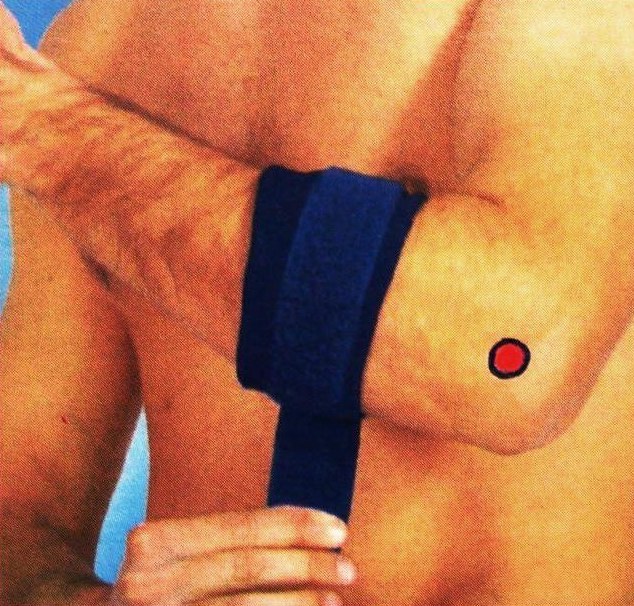
None of this replaces a proper assessment. NHS guidance on tennis elbow suggests avoiding or reducing the activities that make symptoms worse, lists self-care such as cold or warm packs and simple exercises, and advises seeing a GP if pain continues after at least two weeks of rest and self-care. It also notes that physiotherapy may help if symptoms have not improved after about six weeks of home treatment. Forearm straps like the one in the photo above are widely sold; NHS Inform describes the evidence for elbow supports as limited, with possible short-term benefit for some people.
If your pain is sharp, getting worse, waking you at night, or coming with numbness, tingling or weakness in the hand, do not try to solve it with equipment. See a doctor or physiotherapist, tell them you play padel, and bring the racket if you can. They can tell you when, and how much, to play again.
Ready to compare rackets? Start with balance and core, then shape. Our racket guide walks you through the full decision, and the directory helps you find a club where you can demo before you buy.
Frequently asked questions
What is the best padel racket for tennis elbow?
There is no single best model, and no racket has been shown in a study to prevent or cure padel elbow. The setup most often recommended by clinics and specialist shops is a soft EVA or foam core, low or even balance, a weight around 345 to 360 g, and a round head with a forgiving sweet spot. In our racket database, the HEAD Evo Speed (round, low balance, fiberglass face, soft foam, 350 g listed) is the closest match to that profile.
Is a round or diamond padel racket better for tennis elbow?
Round is the usual advice, because round rackets tend to carry their weight closer to the hand and are more forgiving when you miss the center. Balance and core matter more than the label, though. A round racket can still be head-heavy (the Wilson Bela Pro V3 is listed as round with a high balance), so check the balance spec rather than buying on shape alone.
Should I play padel with tennis elbow?
That is a question for a doctor or physiotherapist who has examined your arm. NHS guidance for tennis elbow starts with avoiding or reducing the activities that make symptoms worse, and suggests seeing a GP if pain continues after about two weeks of rest and self-care. If padel reliably makes the outside of your elbow hurt, a new racket is not a reason to keep playing through it.
Do anti-vibration systems in padel rackets help tennis elbow?
The evidence is thin. Tennis research found that small string dampers did not reduce the frame vibration that reaches the forearm. Padel brands market their own vibration-damping systems, but we have not found independent clinical studies showing those systems lower elbow injury rates. Treat them as a comfort feature, not a treatment.
Does grip size matter for tennis elbow in padel?
It can affect how hard you squeeze, which is the part worth paying attention to. A tennis study summarized in the British Journal of Sports Medicine found that a grip about 6 mm over or under the recommended size did not significantly change forearm muscle activity, so the evidence for grip size itself is weak. Aim for a grip that lets you hold the racket loosely without it twisting in your hand.
Is a lighter padel racket always better for a sore elbow?
Not always. Going very light can make you swing harder to get the same depth, and a light racket gives less mass to absorb the ball. Most comfort-focused guidance lands in a middle band of roughly 345 to 360 g with a low or even balance, rather than the lightest racket on the shelf.
Last updated November 16, 2026. This guide is general information about equipment, not medical advice.
Sources
- NHS, “Tennis elbow” (nhs.uk/conditions/tennis-elbow), checked November 2026.
- NHS Inform, “Tennis elbow” (nhsinform.scot), section on elbow supports, checked November 2026.
- De Smedt T, de Jong A, Van Leemput W, Lieven D, Van Glabbeek F. “Lateral epicondylitis in tennis: update on aetiology, biomechanics and treatment.” British Journal of Sports Medicine, 2007;41(11):816–819.
- Blanes C, Correcher A, Martínez-Turégano J, Ricolfe-Viala C. “Identifying the Sweet Spot of Padel Rackets with a Robot.” Sensors, 2023;23(24):9908.
- Li FX, Fewtrell D, Jenkins M. “String vibration dampers do not reduce racket frame vibration transfer to the forearm.” Journal of Sports Sciences, 2004;22(11–12):1041–1052; and Stroede CL, Noble L, Walker HS, Journal of Sports Sciences, 1999;17(5):379–385.
- Racket specs: manufacturer listings as recorded on each PadelAnywhere racket page (last verified August 2026).