Padel racket grip size: you tune it, you don't pick it
In tennis you buy a grip size. In padel, nearly every racket ships with the same handle and you adjust the thickness yourself. Here is how to tell whether yours fits, and how to fix it.
Padel rackets are mostly sold with one factory handle size, so there is usually no size to choose when you buy. Retailers describe that handle as roughly 10.5 cm (about 4 1/8 in) around. The FIP rules only set maximums: a handle up to 20 cm long and 50 mm wide and thick. If the stock handle feels thin, you build it up with overgrips, which add roughly 1.5–2 mm per layer. If it feels thick, you remove a layer. Test it by feel, not by a chart.
Key takeaways
- Most padel rackets use a single handle size; the L1–L5 system from tennis does not apply the same way.
- The FIP rulebook caps the handle at 20 cm long and 50 mm wide and thick; it does not set a standard circumference.
- Retailer hand-measuring charts disagree on the details. Use them as a starting point, then check by feel.
- An overgrip adds roughly 1.5–2 mm; a replacement grip changes the base thickness; stacking has trade-offs.
- Too thin shows up as squeezing and forearm fatigue; too thick shows up as a stiff wrist and lost feel for the grip edges.
- Added layers add a few grams at the butt of the handle, which moves balance slightly toward the handle.
Why padel doesn’t have grip sizes like tennis
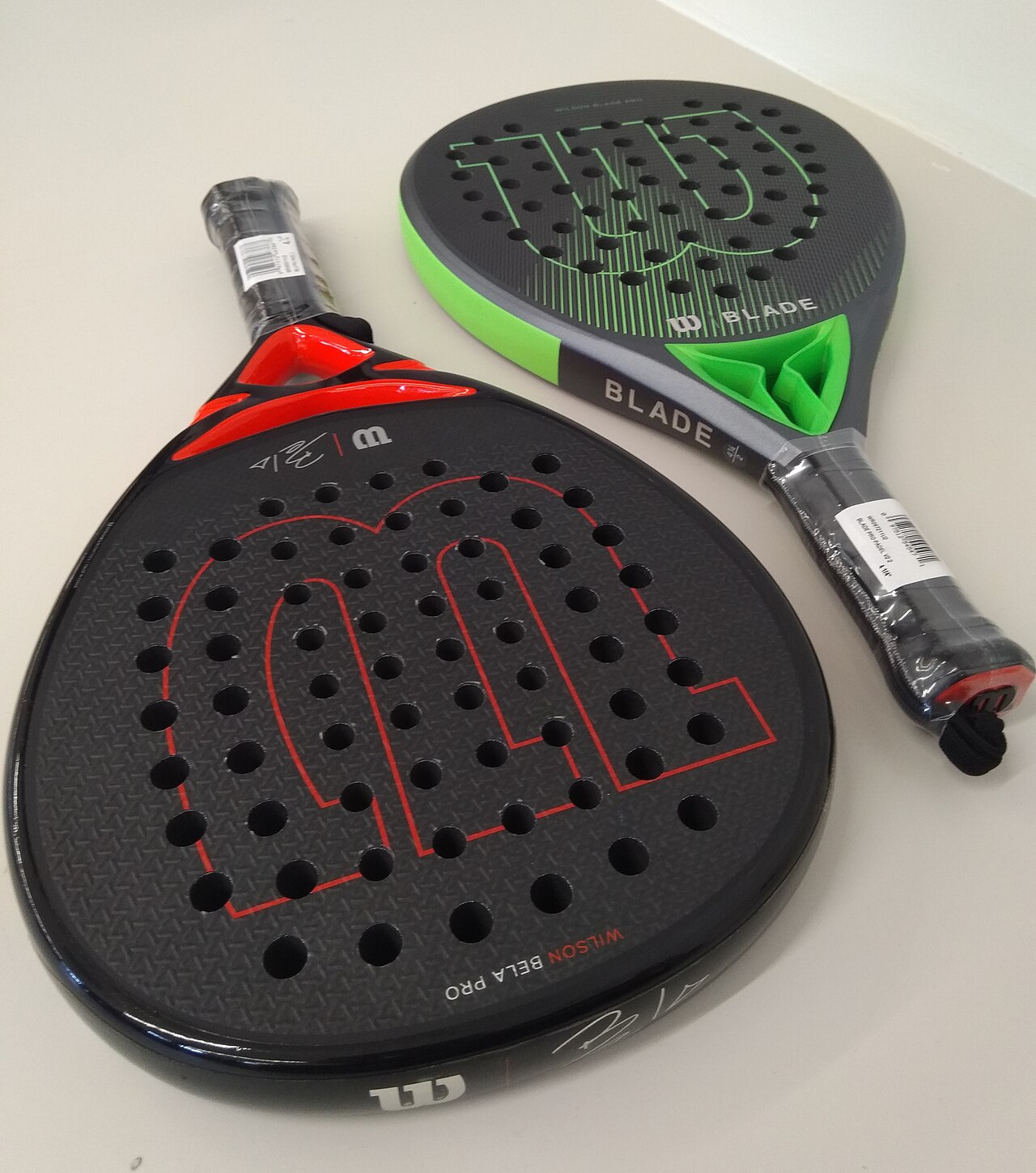
Tennis racquets are sold in numbered sizes, so players choose a grip the way they choose shoe size. Padel works differently. UK Padel Guide describes padel handles as “almost universally a single size,” and says the sport’s shorter handle and different grip mean variation isn’t needed for the mechanics. Padel Gear Lab says nearly every racket in its best-rackets roundup, across brands such as Nox, Bullpadel, Head, Babolat, Adidas and Wilson, ships in one factory handle size, so there is no size selector on the product page.
That doesn’t mean every hand is happy with it. It means the adjustment happens after the purchase, with overgrips or a replacement base grip, rather than at the checkout. If you’re comparing rackets, grip size shouldn’t be the reason you choose one over another; shape, weight and balance matter more. Our racket buying guide covers those.
What the FIP rules say about the handle
The International Padel Federation’s rules of padel describe the handle with maximums only: a maximum length of 20 cm, a maximum width at the throat of 50 mm (not counting the open space), and a maximum thickness of 50 mm. The whole racket, head plus handle, may not exceed 45.5 cm. There is no rule for a minimum or standard circumference, which is why brands settle on one standard size within the limit and why adding layers of overgrip is routine.
Two cautions. First, those figures are cross-section maximums, not a grip size, so don’t read 50 mm as “I can have a handle that big.” Second, the rules also say the racket must be free of attached objects except those that limit deterioration, vibration or distribute weight, in reasonable size and position. Normal overgrips and tape finishing are fine; a bulky wrap of tape isn’t what the rule has in mind. The full list of racket limits is in our padel rules guide.
The standard handle: what retailers actually say
No manufacturer or federation publishes a single industry grip number, so what we have are retailer figures. Ace One Padel gives the standard padel handle as roughly 10.5 cm in circumference, about 4 1/8 inches, with a mildly oval cross-section and a length around 20 cm. UK Padel Guide gives approximately 4 1/8 in or 105 mm. Padel Gear Lab uses a slightly different framing, with European L1, L2 and L3 labels at roughly 95, 100 and 105 mm, and notes that those labels rarely appear on rackets sold through US retailers. The two sets of numbers don’t line up perfectly, which is a good reason to rely on the hand tests below rather than a chart.
A few brands are said to offer slightly thicker handle variants on some models. UK Padel Guide names Bullpadel and Adidas as examples (an L2 variant on certain models) and says other brands are single size. Check the listing for the exact model you are looking at rather than assuming.
Three ways to check whether the handle fits
1. The one-finger test
Padel Gear Lab describes this test, which it attributes to PadelUSA. Hold the racket in a relaxed grip and see whether you can fit one finger between your palm and your fingertips. Too much space suggests the handle is running small for your hand; no space at all suggests it is already snug or slightly large. Padel Gear Lab says most players pass on the factory grip alone.
2. The hand measurement
Retailers also use a ruler method: measure from a crease in your palm to the tip of your ring finger. They disagree on which crease, though. Ace One uses the bottom horizontal crease where the palm meets the wrist. UK Padel Guide uses the second crease line, nearest the fingers. Because the starting point differs, the same hand gives different numbers, so don’t compare your reading to a chart from a different source. Use one method consistently and treat it as a rough guide to how many layers to try first:
| Reading (ring finger method) | Retailer suggestion | Source |
|---|---|---|
| Under about 10 cm | Base grip alone, little or no build-up | Ace One; Padel Gear Lab |
| About 10–11 cm | Usually one overgrip | Ace One; UK Padel Guide |
| About 11–12 cm | Often two overgrips, or a thicker base grip | UK Padel Guide |
These are retailer guidance, not tested standards, and ranges from different sites overlap or shift. If your reading and the finger test disagree, trust the finger test and how the racket feels in play.
3. The continental-grip feel
Racquet Rank describes a right thickness in a continental grip as one where the tips of your middle and ring fingers nearly touch the heel pad of your hand without squeezing. If you are new to the grip itself, start with how to hold a padel racket; a wrong grip can feel like a wrong handle size.
Test a different thickness without changing rackets
Overgrips are the cheap way to tune the handle. Check current options on Amazon.
Signs the handle is too thin or too thick
| Too thin | Too thick |
|---|---|
| You squeeze to stop the racket twisting in your hand | Your wrist feels restricted on bandeja and vibora |
| Forearm tires earlier than the rest of you | You can’t feel the edges of the handle to find a continental grip |
| Racket rotates on off-centre hits | There is no gap at all between palm and fingertips |
Racquet Rank lists the squeezing symptom for a too-thin handle and the restricted wrist for a too-thick one. If elbow or forearm pain shows up, don’t blame the handle alone: racket weight, balance and technique matter too, as we explain in our padel injuries guide. Persistent pain is a reason to see a clinician, not to keep adjusting grips.
How to change thickness: four options
- Add an overgrip. Retailers put each layer at roughly 1.5–2 mm; Racquet Rank says about 1/16 inch (1.6 mm) per layer. It is also the easiest, and cheapest, adjustment, and overgrips need replacing anyway.
- Change the overlap. Ace One says a minimum-overlap wrap adds less thickness than a 50/50 overlap, which doubles the material. That is a way to fine-tune between “one layer” and “two.”
- Swap the base (replacement) grip. Australian Padel Shop describes a moulded sleeve called a Hesacore that replaces the base grip and comes in 1.0, 1.5 and 2.0 mm options, fitted by sliding it on rather than wrapping. If you like the feel of a particular base thickness, this is the way to change it.
- Remove a layer. If the handle feels too big, strip back to a single thin overgrip before you decide the racket is the problem. Our overgrip guide has a section on stacking and on when a full re-grip is needed.
What extra layers do to weight and balance
Every layer adds a few grams at the butt of the handle. Racquet Rank notes this lowers the racket’s balance point slightly, which is the opposite of what a frame protector does at the head. Two overgrips in place of one is a small change, but if you choose a racket specifically because it is head-heavy or head-light, test it with the grips you will really use. Our weight and balance guide explains how balance is measured and how much it moves; and if you add a protector as well, see our racket protector guide for the head-side effect.
Kids, small hands and large hands
Small hands: if your reading is at or below the factory size, start with the base grip alone or a single thin overgrip and use the finger test. Juniors often do best with a lighter racket first; see padel for kids and juniors. Large hands: retailers suggest two overgrips, a thicker base grip or, where a model offers it, a thicker handle variant. If you need more than that, build up gradually and re-test, because very thick handles are what the “too thick” symptoms describe.
A simple order of operations
- Check the base grip. If it has worn through to the handle, you need a new base grip, not another overgrip.
- Do the one-finger test on the racket as it is, relaxed, in your normal grip.
- Measure your hand once, with one method, as a rough guide.
- Try one change at a time: add or remove a single overgrip, or change the overlap.
- Play a full session before changing it again, and watch forearm fatigue and wrist freedom.
- Write down the setup that works so you can repeat it when you re-grip.
Frequently asked questions
What size grip does a padel racket have?
Most padel rackets are sold with a single factory handle size rather than a choice of sizes. Retailers put the standard handle at roughly 10.5 cm (about 4 1/8 inches) in circumference, though that is a retailer figure rather than an FIP rule. The FIP rules only cap the handle at 20 cm long and 50 mm wide and thick, which leaves room for brands to build to one standard and for players to add layers.
Are there padel grip sizes like tennis L1 to L5?
Not in the same way. Some European retailers describe L1, L2 and L3 style labels and say a few brands, such as Bullpadel and Adidas, have offered slightly thicker L2 variants on some models, but they also say the selection is limited and the labels are rare on rackets sold in the US. Treat any L-code as a guide to how many overgrips to add, not as a size to shop by.
How do I know if my padel grip is too small?
Common signs are squeezing hard to stop the racket twisting, a tired forearm late in a session, and the racket turning in your hand on off-centre hits. A simple test described by one retailer is to hold the racket in a relaxed grip and check whether you can fit one finger between your palm and fingertips. If there is more space than that, the handle is running small for your hand.
How do I know if my padel grip is too big?
A handle that is too thick restricts wrist movement on shots like the bandeja and vibora, can blur the edges you feel to find a continental grip, and leaves you with no gap at all between your palm and fingertips. If you have stacked overgrips, remove one and try again before changing anything else.
How much does an overgrip add to a padel handle?
Retailers and guides put one layer at roughly 1.5 to 2 mm of added thickness, depending on the overgrip and how tightly and how much you overlap it as you wrap. Sources describe this as added circumference or diameter, so treat the figure as an approximation and judge by feel rather than by arithmetic.
Will extra overgrips change how the racket plays?
Slightly. Each layer adds a few grams at the bottom of the handle, which pulls the balance point a little toward the handle. Two or three layers is common in padel, but if you are choosing a racket for its balance, try the setup you will actually play with before you decide.
Dial in the handle, then play
Check current overgrips on Amazon, or see what else belongs in your padel bag.
Last updated November 2, 2026 · PadelAnywhere Editorial · Handle measurements and per-layer thickness are retailer figures, not tested by us and not an FIP standard.
Sources
- International Padel Federation, Rules of Padel (the padel racket, items 2, 4 and 8).
- Padel Gear Lab: Padel Racket Grip Size (single factory size, one-finger test, overgrip build-up).
- UK Padel Guide: Padel Grip Size Guide (standard size, hand measurement, L-code variants).
- Ace One Padel: Padel Grip Size Explained (standard circumference, ruler test, overlap effect).
- Australian Padel Shop: Padel Grip Size and How to Fit a Hesacore or Overgrip (replacement sleeve options, fitting).
- Racquet Rank: How to Put an Overgrip on a Padel Racket (per-layer thickness, too-thin and too-thick signs, balance note).